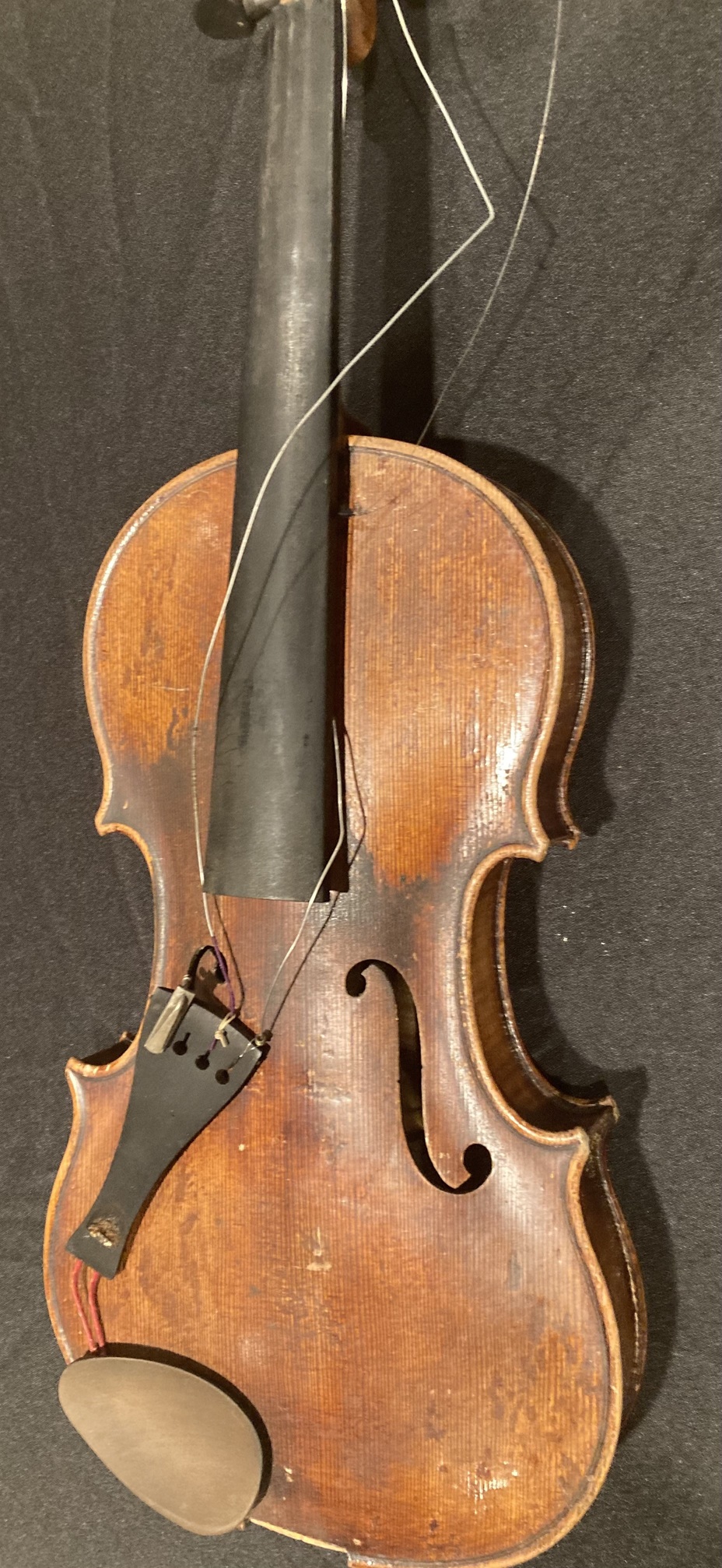
Music once drifted through the windows of a small house in a quiet Belgian village, played by a young Jewish boy who had fled Poland with the only family member he had left—his violin. For a time, its voice seemed to defy the war raging outside. Then one day, the boy did not return to his rented room. His hosts found the violin lying silently on his bed. Eyewitnesses said the boy had been arrested by the Germans, and the instrument’s song was silenced.
After the war, the family entrusted the violin to their niece, Catherine, who longed to learn music. Years later, her aunt revealed its tragic history.
Overcome, Catherine carried the instrument into the fields near her village, laid wildflowers inside its case, whispered a prayer, and closed the lid. She never played it again. For decades, the violin remained untouched, as quiet as its former owner.
Many years later, Catherine saw a television report about Violins of Hope. Fearing the instrument might one day be lost without its story, she contacted master violinmaker Amnon Weinstein. Despite fragile health, she insisted on personally delivering it to Brussels to begin its journey to Israel.
On Amnon’s workbench, the violin was carefully dismantled and restored. Inside its body, he discovered the dried wildflowers Catherine had placed there long ago. He embedded them within the instrument so they would remain part of its story.

Now restored, the violin known as Katrin sings again. Its music carries both the memory of a lost boy and the devotion of the woman who safeguarded it for more than half a century.
Special thanks to Charlotte & Ephraim Gutman Fishgrund (Brussels), Benny Boret (Israel), and Catherine Loodts (Saint Gérard, Belgium) for making its survival possible.