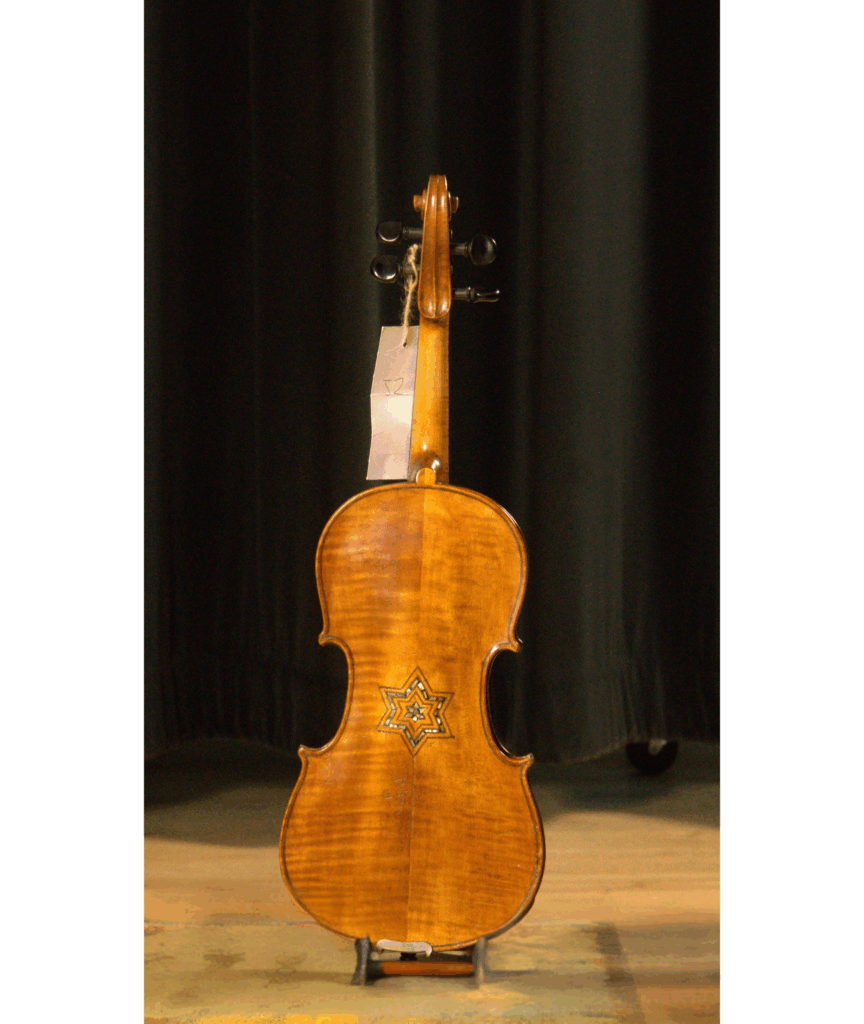
Alfred Eisenberg’s story reflects both the American dream and the shadow of profound loss. Born in Vienna in 1920, the eldest son of Samuel (Jacques) and Leopoldine Amster Eisenberg, Alfred showed early musical promise. By age five he was playing the violin, and by 15 he was performing concerts. His family lived comfortably in Vienna, where his father owned a furniture store and provided well for them, though the political climate grew increasingly hostile.
In the mid-1930s Alfred and his brother Henry were attacked by Brown Shirts while returning from school, foreshadowing the dangers to come. On Kristallnacht, November 9, 1938, their neighborhood was destroyed, forcing the family to seek a way out of Austria. By late 1939, with travel documents canceled for Jews of Polish birth, Alfred, his brother, and mother were detained in a transfer camp. They eventually escaped with only what they could carry—his grandmother concealing silver Shabbat candlesticks, and Alfred taking his Czech violin and family tefillin. The family fled through Holland to England before sailing to America in early 1939, where they settled in Brooklyn.
Alfred became a U.S. citizen, was drafted, and trained at Camp Ritchie, where his fluency in German made him part of the elite “Ritchie Boys.” Skilled in interrogation and intelligence, he was even disguised as a German officer to gather information from POWs. Music remained his solace; though he learned the snare drum for the camp band, the violin always accompanied him home on leave.
After his discharge in 1945, Alfred worked in the paper industry, eventually founding Canover Paper Company in New York. He joined a decades-long class action lawsuit against Austria for reparations, which was only resolved in 2008.
Music remained central to his life. He played Strauss, Rachmaninoff, and gypsy music at gatherings, restaurants, and family events, his violin carrying both beauty and sorrow. The instrument held the weight of memories—of a lost childhood, murdered relatives, and survival.
Alfred passed away in 2004, leaving his violin as a cherished heirloom. Today, its story continues with Violins of Hope, where it no longer rests in silence but shares its voice with the world, bearing witness through music.